The Unvegan

Featured Reviews

Merging Cultures at Chino Bandido
Back to Asia with Taiwan Food Express
A Big Ass Burger at Roaring Fork
Damn Near Perfection at Tokyo Fried Chicken

Reviews

  • Filter by rating
  • all
  • 1
  • 2
  • 3
  • 4
  • 5
  • 6
  • 7
  • 8
  • 9
  • 10

Peking Duck Number 287585 at Quanjude

-
Follow those lights.

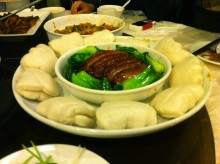
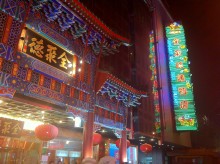
No trip to Beijing is complete without eating some Peking Duck. Now you may be wondering why Peking Duck is so important in Beijing, after all, shouldn’t Peking be the place to get that famous duck? Well, guess what? Beijing is Peking. Yes, I know I’m blowing your mind, but sometimes a mind just needs to be blown and this is one of those times. Anyway, it’s hard to walk a block without seeing a sign for roast duck, which is what they call Peking Duck in Beijing. By recommendation, we were sent to Quanjude Roast Duck Restaurant on Wangfujing Street. This is just one of many Quanjude restaurants (all part of the same company) in Beijing, with the original dating all the way back to 1864. The one we went to on Wangfujing wasn’t hard to find, as Wangfujing is a prominent pedestrian street right in the middle of Beijing.
Eating Hot Pot the Mongolian Way

-
Let’s get a nice boil going in here.

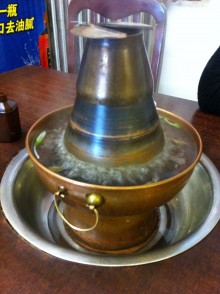
Compared to the Chengdu-style hot pot, Mongolian hot pot looks like it came from another planet. Or at least a much older planet. Differing from most other hot pots, this one still uses hot coals rather than an electric stove. It also looks nothing like a pot and looks more some obscure ancient brass ware you might find at an antique store. The broth, which is essentially water flavored by ginger and scallions, fills a moat that surrounds the central silo. This silo contains the coals that boil the hot pot.

Getting Some Dim Sum at Star Ferry

-
Do these look Chinese to you?

It seems like going to China without eating dim sum is on par with going to Italy and not eating pasta. But in truth, dim sum is really a specialty of Hong Kong and Guangdong (formerly known as Canton). Fortunately, in this day and age, you can find Cantonese restaurants all over China. In Xi’an, we found a place called Star Ferry near the Bell Tower. The interior of the restaurant was decorated like a boat, and I later found out that it was named for a ferry company operating in Hong Kong.

The Shanxi-Style Chinese Hamburger

-
Just like a hamburger.

After living in China for a while, I learned there were quite a few dishes that the Chinese liked to call “Chinese Hamburger.”  Fortunately, none of these involved a trip to McDonald’s, but unfortunately if you don’t speak Chinese, you really don’t know what you’re going to get if you do ask for a Chinese hamburger.  This is because essentially anytime they stick some meat and any other foods inside some sort of bread or bun, they call it a Chinese Hamburger.  One night in Shanghai, we were invited out by a buddy of mine to eat at a Shanxi-style restaurant (not to be confused with Shaanxi, its neighboring province) called Sanjinxiaochu (三晋小厨) near People’s Square in Shanghai and encountered an interesting variation of the Chinese Hamburger.

Pass Me Some Taro Pie

-
This is how McDonald’s does taro.

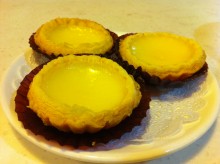
To some, the thought of eating McDonald’s in a foreign country seems just plain wrong. After all, when you’re in a different country, you should be experiencing their culture in all aspects, especially food. And what’s more American than McDonald’s? Yet, it’s hard to deny how much of this American fast food has become a part of other cultures. In Japan and China, a big bucket of KFC is now a Christmas tradition and all over the world you can find Burger King, Subway, McDonald’s and Pizza Hut. And these companies have not simply forced American food down people’s throats. Instead, they have adapted, and few have adapted as well as McDonald’s.

Step into a McDonald’s outside the US and you will see foods you never knew existed. In Canada, you can find Poutine, in Israel there are Kosher McDonalds’ that don’t offer cheese on their burgers. In Japan, the Teriyaki McBurger is like a regular burger, but with a teriyaki twist. These international options almost make McDonald’s a destination, rather than a place to avoid on vacation.

Chengdu Hot Pot with a Shanghai Twist

-
A hot pot divided.

After spending some time in China, you will find that the Chinese people are very prideful, and not simply prideful about their country, but about their regions as well. It seems like if you go anywhere in China, you will hear that whatever region you’re in has the best tea, best dumplings, best noodles and really anything else you can think of (best dog?!). The same goes for hot pot. So if you may think hot pot is simply a bot of boiling water to cook food in, you are wrong.

Classic Xiaolongbao at Nan Xiang Steamed Bun Restaurant

-
So classic-looking.

Just across from Yang’s new location in the new mall on Wujiang Street is another place that serves up xiaolongbao (soup dumplings). It’s called Nan Xiang Steamed Bun Restaurant and cooks them up in the original steamed way. Nan Xiang is actually the part of Shanghai where xiaolongbao originated and you can still find the original in its location near the Yu Garden, but the line is always crazy-long, so when I saw the Nan Xiang restaurant right next to Yang’s, I figured I would give them a taste.

Crispy Xiaolongbao at Yang’s Fried-Dumpling

-
Always a line. Always pink.

Once upon a time, there was a street called Wujiang in Shanghai just outside the Nanjing West Subway Station. At all hours of the day, the street was lined with food vendors and inside the old buildings were delicious, old-school Chinese restaurants. On that street was a hole in the wall called Yang’s Fried-Dumpling, which served a delicious xiaolongbao (pronounced shiao-long-bow) with the special twist that it was fried (as opposed to the traditional steaming method). Xiaolongbao is one of Shanghai’s signature dishes, a dumpling stuffed with pork that creates a soup inside when cooked. The dumpling is sealed air-tight so the soup stays inside until it is eaten. Even though Yang’s went against tradition by frying their dumplings, there was always a line outside their door.

Laying Over with Sushi at Narita

-
Small, like the people.

On our way to my Chinese homeland, the girlfriend and I happened to have a layover at the Tokyo-Narita Airport in Japan. This was great for the girlfriend since she loves her sushi and also great for me because I was hoping to find myself some Melon Fanta. Sadly, the Melon Fanta was nowhere to be found, but at least we found some sushi. The little airport restaurant was appropriately named “Sushi” (I thought Japanese people were supposed to be creative) and we took a seat inside.

Getting My Pupusa on at Flor de Izote

-
Orange!

I’m not the kind of guy who judges a book by its cover. So just because a restaurant looks good on the outside doesn’t mean the food will actually taste good. But there is at least one exception and that is Flor de Izote. Located at the sketchy end of North Hollywood, I took one look at this place and knew it would be awesome. Why? Orange! Everywhere. The entire exterior was orange and so was the interior. And not surprisingly, I was wearing orange that day, so I was pretty much camouflaged. So yes my favorite color is orange, and hell yes I was excited to get down with some food in an orange room.

cURL error: Could not resolve host: schema-pro.com