The Unvegan

Featured Posts

A Touch of Canada at The Kroft
The Best of 2015
Duluth Grill’s Rolled Flank Steak
A Torta at Tortugas

Peking Duck Number 287585 at Quanjude

-
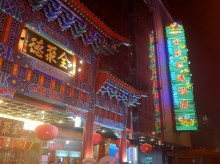
Follow those lights.

No trip to Beijing is complete without eating some Peking Duck. Now you may be wondering why Peking Duck is so important in Beijing, after all, shouldn’t Peking be the place to get that famous duck? Well, guess what? Beijing is Peking. Yes, I know I’m blowing your mind, but sometimes a mind just needs to be blown and this is one of those times. Anyway, it’s hard to walk a block without seeing a sign for roast duck, which is what they call Peking Duck in Beijing. By recommendation, we were sent to Quanjude Roast Duck Restaurant on Wangfujing Street. This is just one of many Quanjude restaurants (all part of the same company) in Beijing, with the original dating all the way back to 1864. The one we went to on Wangfujing wasn’t hard to find, as Wangfujing is a prominent pedestrian street right in the middle of Beijing.
Eating Hot Pot the Mongolian Way

-
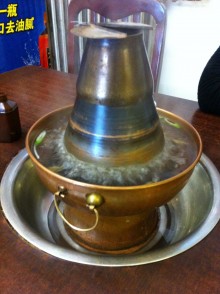
Let’s get a nice boil going in here.

Compared to the Chengdu-style hot pot, Mongolian hot pot looks like it came from another planet. Or at least a much older planet. Differing from most other hot pots, this one still uses hot coals rather than an electric stove. It also looks nothing like a pot and looks more some obscure ancient brass ware you might find at an antique store. The broth, which is essentially water flavored by ginger and scallions, fills a moat that surrounds the central silo. This silo contains the coals that boil the hot pot.

Street Food Spotlight: Xi’an’s Islamic Street

-
Skullcaps and ground meat.

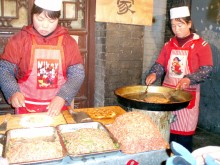
To many people, it’s surprising to find out that China isn’t a country full of just one ethnicity. In fact, China is home to 55 different ethnic minorities and actually has a significant Muslim population. A big part of that population is the Uyghur (pronounced wee-gur) people, who mainly reside in Xinjiang, a western province that borders Central Asian countries like Kazakhstan, Kygyzstan and Afghanistan. But Chinese Muslims can be found all over the country and in major cities like Xi’an in Shaanxi Province. While the Terracotta Warriors are surely the biggest draw to Xi’an, the city also has China’s biggest mosque, which looks like any other temple in China except for the Arabic writing. Xi’an also boasts some delicious Muslim food.

Getting Some Dim Sum at Star Ferry

-
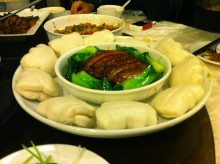
Do these look Chinese to you?

It seems like going to China without eating dim sum is on par with going to Italy and not eating pasta. But in truth, dim sum is really a specialty of Hong Kong and Guangdong (formerly known as Canton). Fortunately, in this day and age, you can find Cantonese restaurants all over China. In Xi’an, we found a place called Star Ferry near the Bell Tower. The interior of the restaurant was decorated like a boat, and I later found out that it was named for a ferry company operating in Hong Kong.

Street Food Spotlight: Xi’an Skewer Sandwich

-
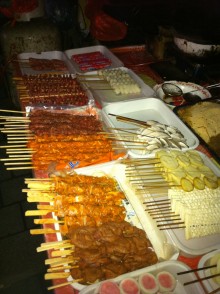
Just try to name those meats.

After Shanghai, we headed to Xi’an to see the Terracotta Warriors. We landed at night and although it was pretty late, I was a hungry unvegan. I remembered Xi’an having some great late-night street food, but after four years so much had changed in China and I hoped this was not one of them. I took a quick stroll just south of the Bell Tower and found just what I was looking for. While Shanghai had some good street skewer food (none of which I actually had on this trip), it was nothing compared to what could be found in Xi’an.

The Shanxi-Style Chinese Hamburger

-
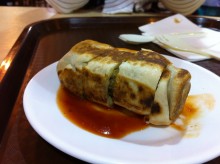
Just like a hamburger.

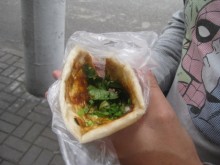
After living in China for a while, I learned there were quite a few dishes that the Chinese liked to call “Chinese Hamburger.”  Fortunately, none of these involved a trip to McDonald’s, but unfortunately if you don’t speak Chinese, you really don’t know what you’re going to get if you do ask for a Chinese hamburger.  This is because essentially anytime they stick some meat and any other foods inside some sort of bread or bun, they call it a Chinese Hamburger.  One night in Shanghai, we were invited out by a buddy of mine to eat at a Shanxi-style restaurant (not to be confused with Shaanxi, its neighboring province) called Sanjinxiaochu (三晋小厨) near People’s Square in Shanghai and encountered an interesting variation of the Chinese Hamburger.

Street Food Spotlight: Chou Doufu

-
If only we had smellovision.

Just what is chou doufu (pronounced cho dough-foo)? If you don’t know Mandarin, you might think it sounds pleasant. The words roll off the tongue pretty cleanly and it sounds like it could be some sort of doughy deliciousness. Like a doughnut or something. But if you know Mandarin, then you know the true meaning of the words and they are nothing at all like a doughnut. Chou doufu means, quite literally, stinky tofu. And the name is certainly appropriate. As with much of the rest of Chinese cuisine, chou doufu comes in many forms, but the form I know best can be found on the street.

Eating Sri Lanka at the Shanghai World Expo

-
This godamba is making me thirsty.

By now you may be wondering why I’m posting all about food in China. First and foremost, it was for vacation, but it was also to check out the Shanghai World Expo. If you don’t know what the Expo (formerly known as the World’s Fair) is, it’s basically a huge event lasting a few months where countries are given the opportunity to build pavilions to show off their nations. Some create beautiful works of architecture (remnants of past fairs include the Eiffel Tower and Ferris Wheel), some show off aspects of their culture and some simply use their pavilion to sell products from their country. Some even had local foods to eat, and that interested me the most.

Street Food Spotlight: Cong You Bing

-
It’s like a pancake, but scalliony.

In my experience, I’ve learned that some of the best food in the world can be found on the street. No, not literally on the street (although the 10 second rule certainly applies for some of this food), but food that is sold on the street rather than from some brick and mortar building. A major part of the allure is the tracking down of the street food. There’s no address, so you really just have to stumble upon it. Plus, since it’s mobile and there are no hours, there’s no guarantee the food will be there again the next time you look for it. The biggest part of the allure, though, is the taste. It takes someone with an iron will to seek out this kind of food, but when you find something great, the payoff is huge.

Pass Me Some Taro Pie

-
This is how McDonald’s does taro.

To some, the thought of eating McDonald’s in a foreign country seems just plain wrong. After all, when you’re in a different country, you should be experiencing their culture in all aspects, especially food. And what’s more American than McDonald’s? Yet, it’s hard to deny how much of this American fast food has become a part of other cultures. In Japan and China, a big bucket of KFC is now a Christmas tradition and all over the world you can find Burger King, Subway, McDonald’s and Pizza Hut. And these companies have not simply forced American food down people’s throats. Instead, they have adapted, and few have adapted as well as McDonald’s.

Step into a McDonald’s outside the US and you will see foods you never knew existed. In Canada, you can find Poutine, in Israel there are Kosher McDonalds’ that don’t offer cheese on their burgers. In Japan, the Teriyaki McBurger is like a regular burger, but with a teriyaki twist. These international options almost make McDonald’s a destination, rather than a place to avoid on vacation.

cURL error: Could not resolve host: schema-pro.com